An introduction
Meet Fenia:
the archaeologist who teaches Greek through its culture.
Since you're here, let me say it properly first: καλωσόρισες (kalosórises, welcome). Pull up a chair. Before I teach you a single word of Greek, I'd like you to know who's on the other side of the screen.
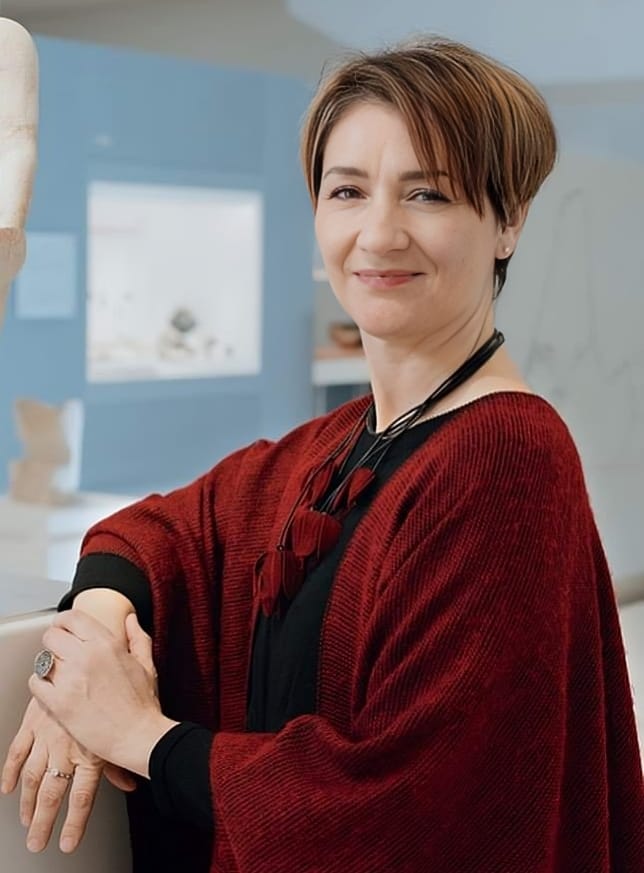
I'm Chrysafenia. Everyone calls me Fenia.
From Alexandroupoli, Greece
Where I'm from
Beside the Thracian Sea.
I'm from Αλεξανδρούπολη (Alexandroúpoli), a seaside town in the far north-east of Greece, in Thrace, where the land runs out and the Thracian Sea begins. On a clear day you can see the island of Samothrace floating on the horizon. Most foreigners have never heard of my corner of Greece, which is a quiet shame, because it has extraordinary history, landscape, and light.
I've spent almost my whole life here, beside this water. It shaped me more than any classroom did.
Chrysafenia Pardalidou
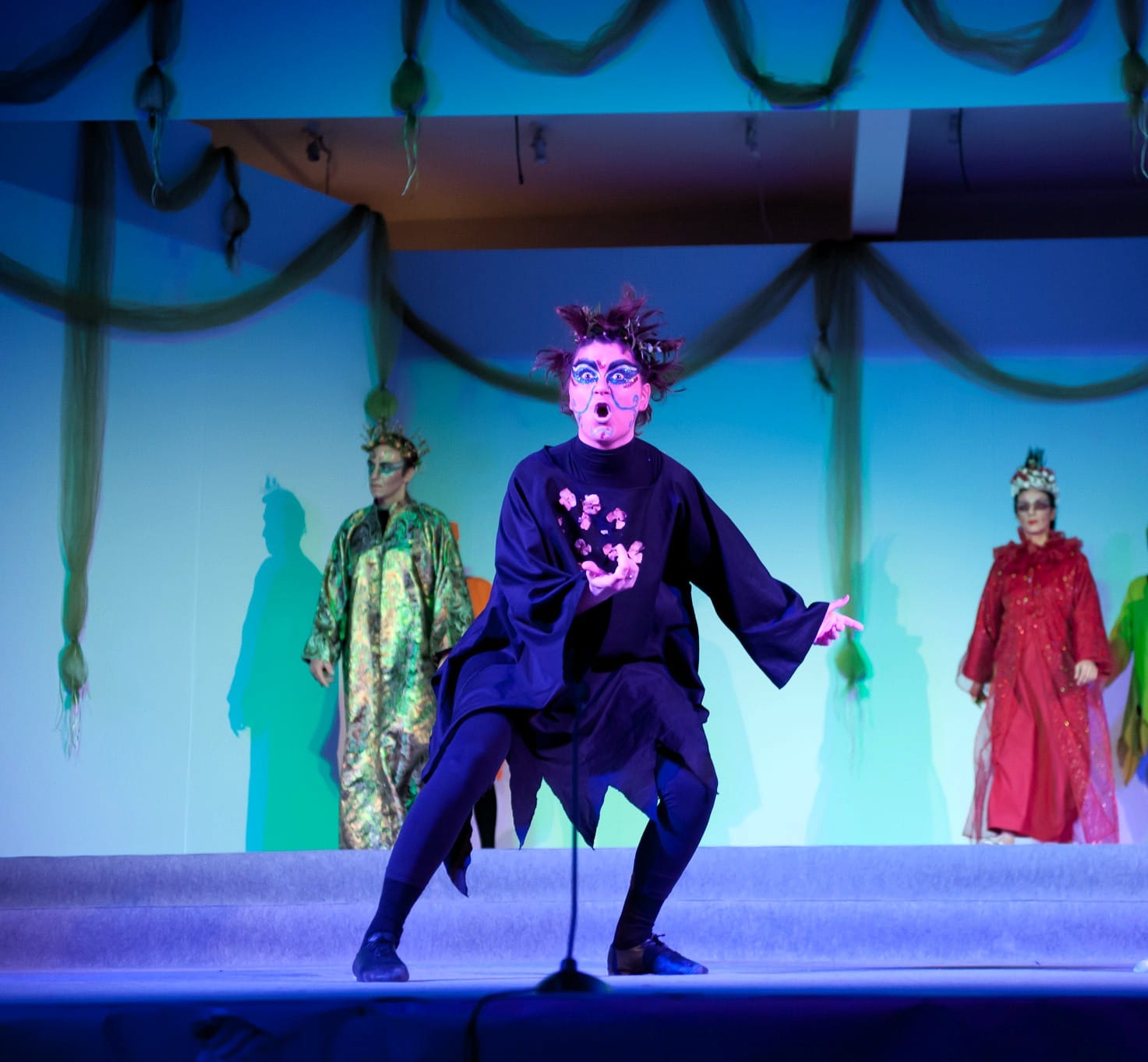
Me on stage
The long way to this work
A strange and lucky child.
I was a strange and lucky child. I drew constantly, wrote stories, and directed small theatrical plays with the other children in the neighborhood, casting them whether they wanted parts or not. A book about travelling back in time to ancient Greece lit something in me early. Indiana Jones, a little later, sealed it.
My heart wanted the stage and the open road. But life nudged me toward something close to art and ancient at once, and so I became an archaeologist. I studied History and Archaeology in Ioannina, then earned an MA in Classical Archaeology in Thrace and an MSc in Cultural Management, both while raising my two children as a single mom, both finished with stubborn determination and good marks.
For over twenty-five years, archaeology and cultural heritage have been my world. I've managed museums and ancient sites in my region, published research, stood at conference podiums, and spent more hours than I can count among old stones and older stories. Languages and culture have always been at the center of everything I do.
And alongside all of that, for more than twelve years, I taught. Modern Greek, ancient Greek, history, Latin, to students preparing for exams and to foreigners trying to find their footing in my language. Teaching was never the thing I was supposed to do. It turned out to be the thing I loved most.
Why the Wise Greek Owl Project exists?
The scholar and the storyteller,brought together.
A couple of years ago, something in me said it was time to bring all of it together, the scholar and the storyteller, the archaeologist and the teacher, the woman who genuinely cannot stop talking about Greek words at dinner parties.
So, I built The Wise Greek Owl Project.
It came from one belief I hold deeply: learning Greek is not really about grammar or vocabulary. It's about understanding how Greeks think. It's about feeling confident in real life, the café, the doorway, the village square. It's about belonging, not just visiting. Greek isn't only a language. It lives in gesture, tone, emotion, history. It's a bridge between an ancient civilization and a very alive modern one, and I want to walk you across it.
I'm not interested in burying you in rules. I've watched too many people quit Greek that way, convinced they were simply "bad at languages," when really they'd just been taught backwards. My way is the opposite. We speak first. We feel the language. We let the culture carry the grammar in gently, when you're ready for it.
"Discover the language, embrace the culture."
That's the whole philosophy — and I'll repeat it to you often.
Off the page
What I'm like when I'm not teaching.
I think you should know your teacher as a person, so here's the rest of me.
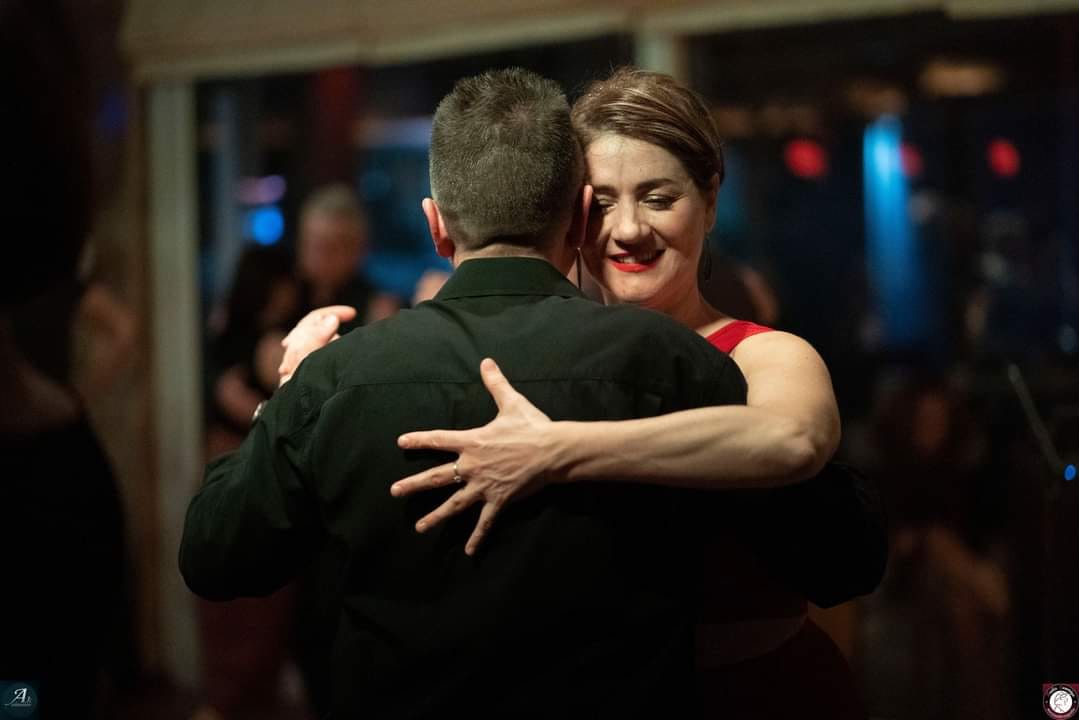
When I'm not at my desk, you'll probably find me on a stage. I've performed in amateur theatre for over twenty years, leading roles, supporting roles, once directing a piece about refugees that still sits close to my heart. I dance Argentine tango. I travel whenever I can, and I write about it on my own little travel blog, purely for the love of it. I drink tea, not coffee, which is mildly scandalous for a Greek.
All of this finds its way into how I teach. Theatre taught me that language lives in the body and the breath, not on the page. Travel taught me what it feels like to be the stranger trying to find the right words. Both are reasons my lessons don't look much like lessons.
Με αγάπη, Fenia · The Wise Greek Owl
What I believe about you
You don't need to be perfect. You never did.
Here's what I want you to hear, especially if Greek has frightened you before.
You don't need to be perfect. You never did. You don't need to master the cases before you're allowed to speak. You need warmth, a safe place to make mistakes, and someone who believes you can do this, because you can. I've seen it too many times to doubt it.
Greek is not impossible.
That's perhaps the most common thing I'm asked to disprove, and I disprove it with every single student.
So, if your dream is to feel at home in Greece, to handle daily life with ease, to truly connect with people through the language, you're in the right place. And if you're still wondering whether a language this old, spoken by relatively few, is worth your evenings, I wrote you something honest about why this language is worth learning.
I'm really glad you're here.
Begin gently
A word, a story, a piece of Greece each week.
The best way to begin is gently. My free email Circle sends you a word, a story, or a piece of Greece each week, no pressure, no overwhelm, plus two welcome gifts to start you off. Come and join us here. And if you'd rather just meet me and say your first Greek words out loud, I keep a few spots each week for a free, relaxed chat. No lesson, no sales pitch. Just hello.
Με αγάπη, from Alexandroupoli,
Fenia
The Wise Greek Owl